ES
ES  EN
EN  FR
FR Why many PrestaShop modules fail when your store starts to grow
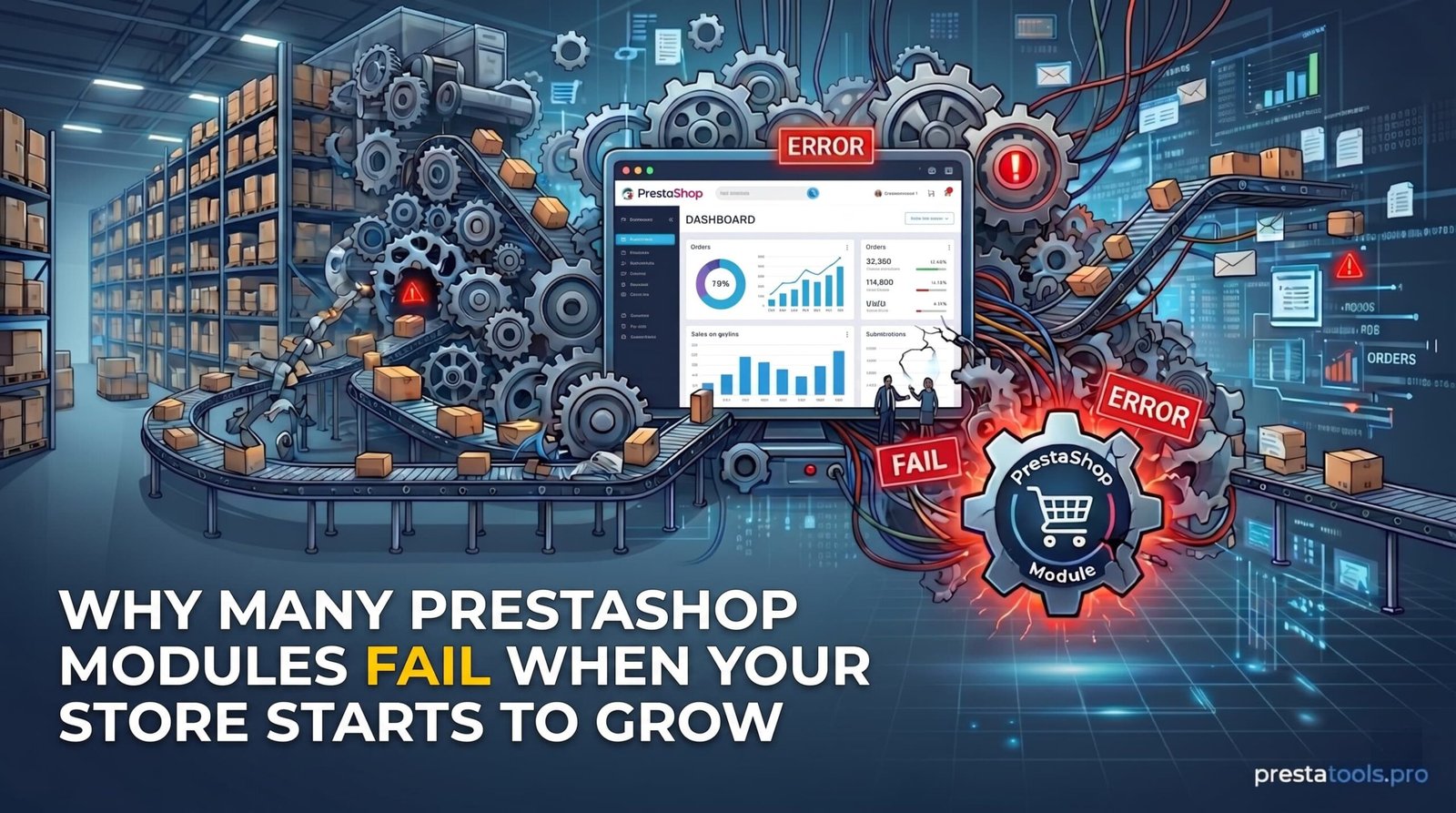
When a PrestaShop store is just starting out, almost everything seems to work fine.
Pages load fast, the back office is responsive, and modules do their job.
The problem appears when the business starts to grow.
More traffic.
More products.
More orders.
More integrations.
That’s when some modules start to show their limits.
And usually, the problem isn’t PrestaShop.
Growth puts code quality to the test
A small store can tolerate minor development errors.
A store with thousands of daily visitors cannot.
Many modules are designed to work in simple environments, but not to handle:
- high query volumes
- large catalogs
- multiple combinations
- external integrations (ERP, CRM, marketplaces)
- shared servers with limited resources
When a module isn’t optimized, every new page load multiplies the problem.
The most common mistakes in poorly developed modules
1. Heavy queries on every page
Some modules run complex database queries on every page load.
In a small store, it may go unnoticed.
With hundreds of simultaneous users, performance collapses.
2. Excessive use of overrides
Modifying core classes may seem like a quick fix.
But in the long run it causes:
- conflicts between modules
- incompatibilities after updates
- hard-to-detect dependencies
A store with multiple accumulated overrides becomes fragile.
3. Unnecessary features
Some modules promise to do everything.
The more options, configurations, and background processes, the higher the risk of:
- unexpected errors
- conflicts
- unnecessary resource consumption
A good module solves a specific problem efficiently.
The real impact on a live store
When a module fails in an active store, the consequences aren’t just technical.
They’re financial.
- lost sales
- checkout errors
- back office crashes
- poor user experience
- time spent on support
And worst of all: business interruptions.
How to tell if a module is ready to scale
Before installing a module, it’s worth asking:
- Does it respect the PrestaShop core?
- Does it properly use hooks and best practices?
- Is it optimized for performance?
- Is it easy to maintain and update?
- Is it designed for real production environments?
If the answer is uncertain, the module could become a future problem.
Our approach at PrestaTools
At PrestaTools, we develop modules designed for stores that want to grow.
That means:
- clean and structured code
- minimal performance impact
- zero unnecessary core modifications
- compatibility with future versions
- stability over complexity
We prefer solid and scalable solutions over spectacular but fragile modules.
Conclusion
PrestaShop is a powerful platform built to scale.
But a store’s stability largely depends on the components it’s built with.
Choosing well-developed modules isn’t a technical detail.
It’s a strategic decision.
Because when your store grows, everything multiplies.
Sales… and problems too, if you haven’t built on a stable foundation.
¿Buscas módulos PrestaShop que no fallen cuando tu tienda crece?
En PrestaTools desarrollamos módulos pensados para entornos reales. Código limpio, sin impacto en velocidad y soporte técnico directo.
Ver catálogo de módulos →